
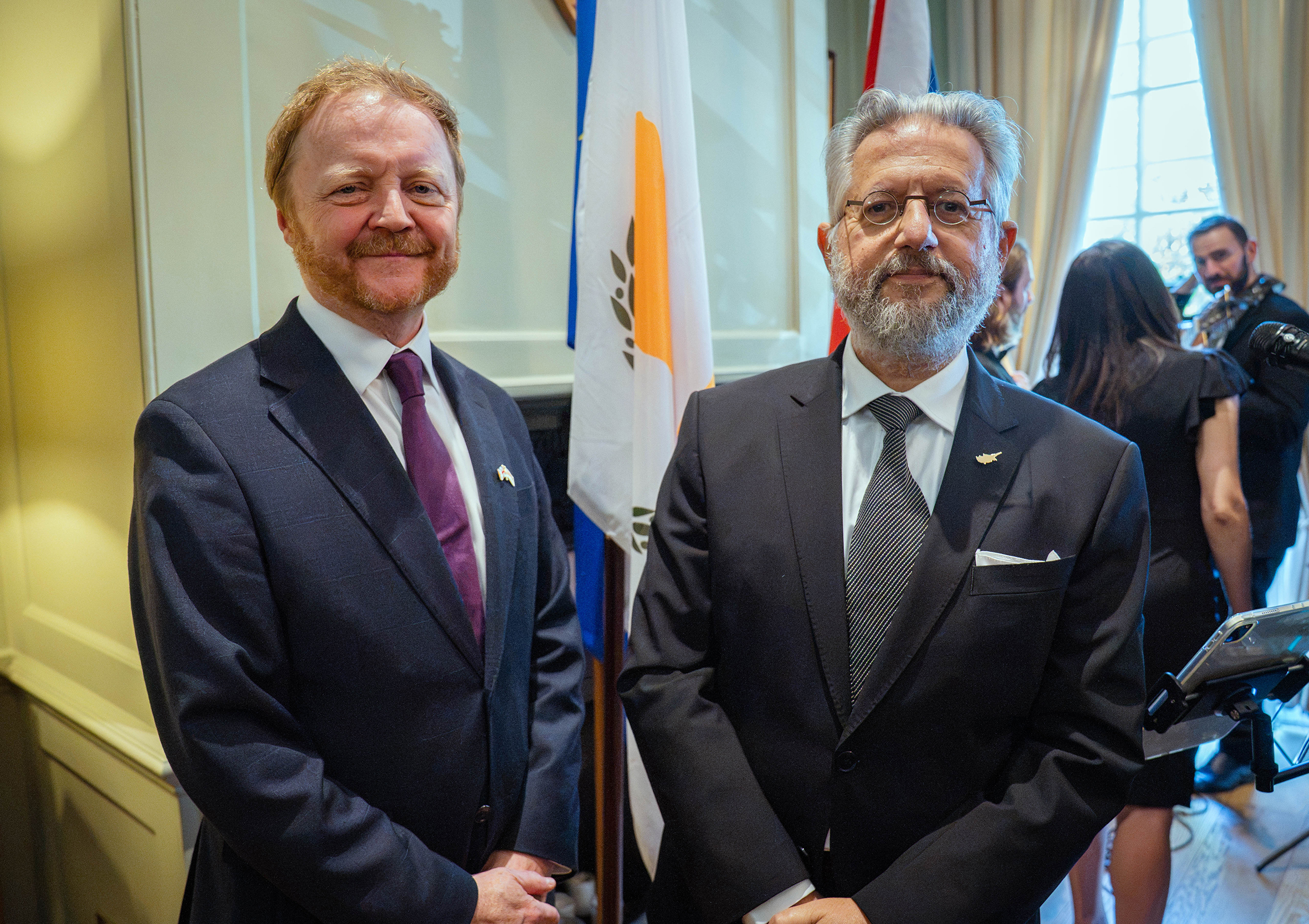
Remarks by the High Commissioner of the Republic of Cyprus to the UK, Dr Kyriacos Kouros, at the reception on the occasion of the 66th Anniversary of the Independence of the Republic of Cyprus
Residence of the High Commissioner, London
It is a pleasure to welcome you as we mark the 66th anniversary of the independence of the Republic of Cyprus, celebrating the historic transition from colonial rule, and following centuries of occupation by trespassing empires.
The anniversary of the establishment of a state, particularly in the case of Cyprus, is a moment mostly of reflection. The Republic of Cyprus has overcome formidable challenges to become a resilient, outward-looking member of the international community and an active partner in global affairs. In a period marked mostly by conflicts, uncertainty and geopolitical tensions, we try to be an anchor of stability and a bridge for cooperation.
Our geography brings challenges, but also the responsibility to facilitate humanitarian action and regional partnerships. We dare see nowadays ourselves as a reliable partner—practical, result-oriented and eager to help anyone in need. To be part of solutions and a collective system of European values which we believe we deliver. That same outlook guided our Presidency of the Council of the European Union earlier this year.
We have demonstrated this commitment through our contribution to humanitarian assistance and the evacuation of civilians from surrounding crisis areas, including through the Maritime Humanitarian Corridor and our national emergency action plan designed to use our island as a safe humanitarian and transit hub to receive, temporarily host, and repatriate any nationals fleeing conflict zones or natural disasters in the wider Middle East.
Our partnership with the United Kingdom could always be central to that effort. It is rooted in a complex shared history, but today it is increasingly defined by a forward-looking strategic agenda. Our Strategic Dialogue is giving new momentum to cooperation in foreign policy, defense and security, trade and investment, education, research and innovation and joint responses to emerging threats.
We also see considerable scope for further work on maritime security, information sharing and the resilience of our societies and economies. As a member of the European Union, Cyprus was always a committed advocate of a strong, constructive EU–UK relationship and we are eager to hear the options the new British PM will present before the end of the year for the people of the UK to decide what kind of relationship they want to be part of.
The Cyprus-UK economic and social ties are equally substantial. British and Cypriot businesses cooperate in trade and investment, financial and professional services, accounting, shipping, tourism, technology and energy. Our universities and research centers build partnerships in science and innovation; our institutions cooperate in education, archaeology and culture. These are not merely areas of potential: they are living connections that bring tangible benefits to both countries.
Where differences arise, including over matters relating to the sui generis “Sovereign Base Areas”, two militarized areas in the island where only Cypriot citizens reside permanently, we believe that the strength of our partnership will permit us to address them frankly and constructively.
Above all, the British Cypriot community gives this relationship its enduring human dimension. Cyprus diaspora in the United Kingdom is estimated up to 450.000 people. Across generations since the start of the 20th century, Cypriots have contributed to most fields of British public life, businesses, medicine, science, education and the arts, while preserving at the same time a strong attachment to their heritage. They remind us that the most resilient international partnerships are sustained by people.
Cyprus attaches particular importance to multilateralism and the international rules-based order. Of course, this does not make naïve. We are all aware how this order is tested today but it was always tested. We know this because we suffered since the establishment of our state when the rules were bend in favor of the strongest. For smaller states however, international law and effective multilateral institutions remain still the essential safeguards.
Therefore, we value our active membership of the Commonwealth, which connects countries across continents and provides a practical forum for cooperation on democracy, development, climate resilience and shared challenges. Our Commonwealth partnership with the United Kingdom is an additional foundation of our bilateral relationship.
Moreover, here in London, the International Maritime Organization has special significance. Recent threats to seafarers and vessels, and disruption around the Strait of Hormuz, show how quickly regional conflict can affect energy supplies, international trade and the global economy. Freedom of navigation and the protection of seafarers are matters of international security and collective responsibility.
Cyprus will continue to support the IMO’s work and the leadership displayed by the SG, [our good friend Arsenio], as also the international maritime law, and cooperation with partners such as the United Kingdom.
As we take stoke of the achievements of the Republic of Cyprus, we cannot overlook the most important unfinished task, namely the reunification of Cyprus. My country remains partly occupied since the confrontational events which led to the Turkish invasion –military intervention, in the summer of 1974; and what is more concerning is how much our society remains divided ever since– due to the traumatic events that our society has experienced.
Coming to the today, our prominent adversary, Türkiye, is not showing any signs of willingness to allow us a long overdue return to the table of negotiations –despite the efforts of the sitting United Nations Secretary General.
The President of the Republic of Cyprus repeated before the UN general assembly last month that we remain fully committed to achieving a functional and viable solution. We are ready to resume negotiations from where they were left off, building on the substantial work already achieved.
The common ground is there: the relevant UN Security Council Resolutions, the specific provisions of international law, and the relevant principles of the European Union of which we are a member. The UN Security Council has established the framework for the settlement. That framework, of a bizonal bicommunal federation with political equality remains the only basis, on which a comprehensive settlement must be reached. In other words, our goal is a peaceful, secure and prosperous common future for all Cypriots alike.
In achieving this objective, we need the support of strong partners. The UK is one of those.
Lord Wood,
The United Kingdom has a particularly important part to play –as one of the guarantor powers, as one of the permanent members of an unfortunately fragmented UN Security Council and the penholder on Cyprus. We value your government’s stance so far– and we expect your government to carry on its principled support for the UN-agreed basis of settlement and look to its continued constructive engagement in helping bring the parties back to meaningful negotiations. The international legal principles of independence, sovereignty, and territorial integrity must be applied consistently, in Cyprus as elsewhere.
Our relationship with Britain is strong enough to embrace frank discussion –and ambitious enough to deliver practical results. As we look to the future, let us build on that partnership in the service of peace and prosperity– for our two countries, for Europe and the whole world.
Thank you all for being here to celebrate and reflect with us.
Long live the Republic of Cyprus!
Long live the relations between Cyprus and the United Kingdoom!
Legal Disclaimer:
EIN Presswire provides this news content "as is" without warranty of any kind. We do not accept any responsibility or liability for the accuracy, content, images, videos, licenses, completeness, legality, or reliability of the information contained in this article. If you have any complaints or copyright issues related to this article, kindly contact the author above.
